The crossing of the desert
The Horse and His BoyThe crossing of the desert is the fugitives’ arduous night-and-day passage from the vicinity of Tashbaan to Archenland, made urgent by Aravis’s warning that Rabadash is preparing an expedition. The desert reduces their escape to a test of endurance and attention: they must keep moving across apparently endless sand, conserve what little water they have, and follow the route Shasta has worked out. Its hard-won reward is not safety but a way forward—first the valley and its water, then the river that marks their arrival in Archenland.
Causes and Departure
The journey becomes a race against Rabadash after Shasta emerges from hiding and Aravis tells him, Bree, and Hwin about the expedition. Bree reacts with anger at the prospect of an attack during peacetime without a challenge having been sent, and insists that they may still reach their destination first. His confidence is qualified by practical knowledge: a company of two hundred horse and horsemen cannot be watered, provisioned, armed, saddled, and sent out instantly. That delay gives the fugitives a chance, but not much of one.
The party sets off with Shasta directing the route. When Bree asks whether they should go due north, Shasta says he has drawn a line and directs both horses a little to the left, postponing his explanation. His map-reading turns out to matter: at sunrise he spots that they are slightly off course and calls for a correction toward Mount Pire. The destination is therefore reached not by blind speed but by combining Bree’s judgment of what the horses can sustain with Shasta’s attention to direction.
Bree rejects the storybook idea of galloping for a whole day and night. The travelers will alternate brisk trots with short walks, and the children can dismount during the walking stretches. He sets the pace and gives the departure its rallying cry: “Narnia and the North!” The phrase frames the crossing as both an escape from Tashbaan and a purposeful ride toward the northern lands, even while the party has yet to overcome the desert between them and that goal.
The Ordeal of the Sand
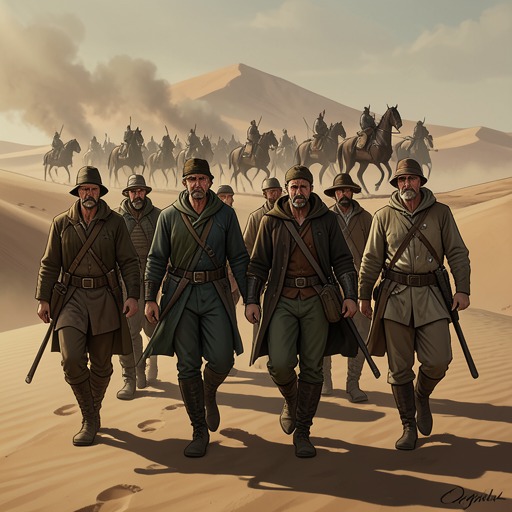
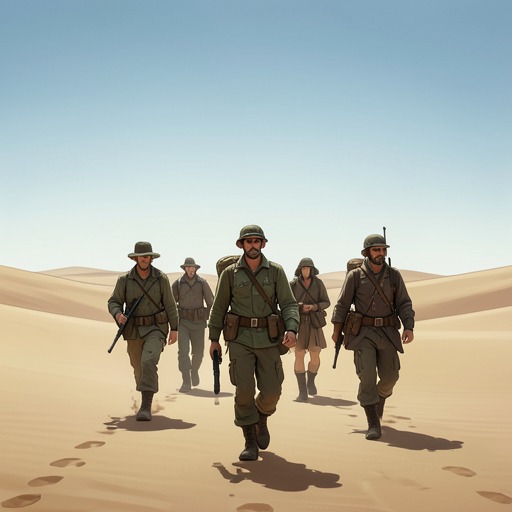
At first, night makes the desert seem almost gentle. The sand gives back the day’s heat, the air is cool and clear, and moonlight spreads over the ground until it gleams like water. The quiet and steady hoofbeats nearly lull Shasta to sleep. Yet the journey has already begun to exact a cost: he must dismount whenever the horses walk, and keep himself awake through the repeated changes of pace.
As the moon disappears, the ride becomes a passage through darkness. Gradually the desert shows itself as a vast, gray, apparently lifeless flatness. Shasta grows terribly tired and cold; his lips dry, while the squeak of leather, jingle of bits, and muffled hoofbeats on sand continue around him. Dawn arrives without birdsong. Mount Pire offers a distant point of reference, but the light that makes the landscape visible also brings glare, and the sunrise’s brief lift in spirits cannot make the journey feel shorter. Looking back, the fugitives see Tashbaan diminished in the distance, with the Tombs of the Ancient Kings swallowed into the jagged outline of the city of the Tisroc.
In daylight, the desert’s apparent stillness becomes a strain of its own. Tashbaan seems not to recede and the mountains not to draw nearer. The sun glares off the sand; when Shasta dismounts, heat rises into his face, and eventually the sand burns his bare feet so badly that he scrambles back onto Bree. Bree immediately understands and tells him to stay mounted. The adjustment is small but necessary: the marching intervals that had made the pace possible for the horses are no longer bearable for Shasta.
The heat and monotony continue mile after mile, punctuated by the jingling tack, squeaking leather, and the smells of hot horses and riders. Thirst occupies Shasta’s thoughts despite his efforts to suppress them; he imagines iced sherbet, spring water, and milk. A rock outcrop, about fifty yards long and thirty feet high, offers a patch of shade where the four crowd together to eat and drink. Bree and Hwin manage to drink from a skin bottle, but nobody has enough. The horses are flecked with foam and breathing noisily; the children are pale, and no one speaks. The rest is short, and the party has to resume its journey still depleted.
Finding Water
As the sun sinks, the fugitives keep watching for the valley Sallowpad the Raven had described. Evening removes the worst of the glare but not the heat rising from the sand, and the level desert continues with no sign of their refuge. The horses thunder onward while the children, miserable with thirst and weariness, rise and sink in their saddles. Only after the moon has risen does Shasta, his mouth so dry that his voice sounds strange and barking, call out that he has seen it.
The valley is unmistakable once found: a slope descends ahead and slightly to the right, with hummocks of rock on either side. Too tired to speak, Bree and Hwin turn toward it. The ravine initially offers little comfort. Its rocky walls hold a breathless stuffiness and block much of the moonlight; the route falls steeply between cliff-like sides. Cactus-like plants and coarse grass appear, and stones and pebbles replace sand beneath the horses’ hooves. The travelers repeatedly hope for water at each bend, while Hwin stumbles and pants behind Bree. The discovery of a route out of the open desert thus does not immediately relieve their danger.
At last, small signs of water grow into a source that can sustain them: a muddy trickle becomes a brook, the brook a stream, and the stream a river. After further disappointments, Bree stops beside a little cataract pouring into a broad pool. The horses have already gone into the water and are drinking. Shasta plunges in, stoops his head beneath the cascade, and drinks; the moment is described as perhaps the loveliest of his life. The scene reverses the crossing’s governing deprivation: water, previously an imagined pleasure and a painfully inadequate ration, is suddenly present in abundance.
Arrival in Archenland
After drinking, the travelers emerge wet, and the moon reveals the setting of their refuge: soft grass beside the river, trees and bushes rising toward the cliffs, and a glade filled with the scents of flowering shrubs hidden in shadow. A nightingale sings from the darkest recess among the trees, a sound Shasta has never heard before. Exhaustion still governs their bodies. The horses lie down without being unsaddled, and Aravis and Shasta lie down too; the immediate reward is rest rather than renewed movement.
The next stage carries them down the valley for several hours. It widens until they can see its river joining a broader, turbulent river flowing east. Beyond that water, green hills rise in ridges toward the Northern Mountains. Mount Pire is no longer visible; ahead, the mountain range sinks to a wooded saddle that marks the pass from Archenland into Narnia. The landscape announces a sharp change from the exposed, nearly treeless waste: Bree greets the green North with delight, and the lower hills appear strikingly fresh to Aravis and Shasta, whose eyes are accustomed to the south.
The eastern-flowing river is too swift and broken by rapids to swim. After searching up and down the bank, the travelers find a shallow place and wade across. Bree proudly declares that they are in Archenland and identifies the river, tentatively, as the Winding Arrow. Hwin’s response is less celebratory: she hopes they have arrived in time. Their crossing of the desert is complete, but the urgency that drove it remains. They climb slowly and zigzag up steep, open, park-like hills, with scattered trees, rabbits, and a herd of fallow deer around them, continuing toward the kingdom whose danger brought them across the sand.